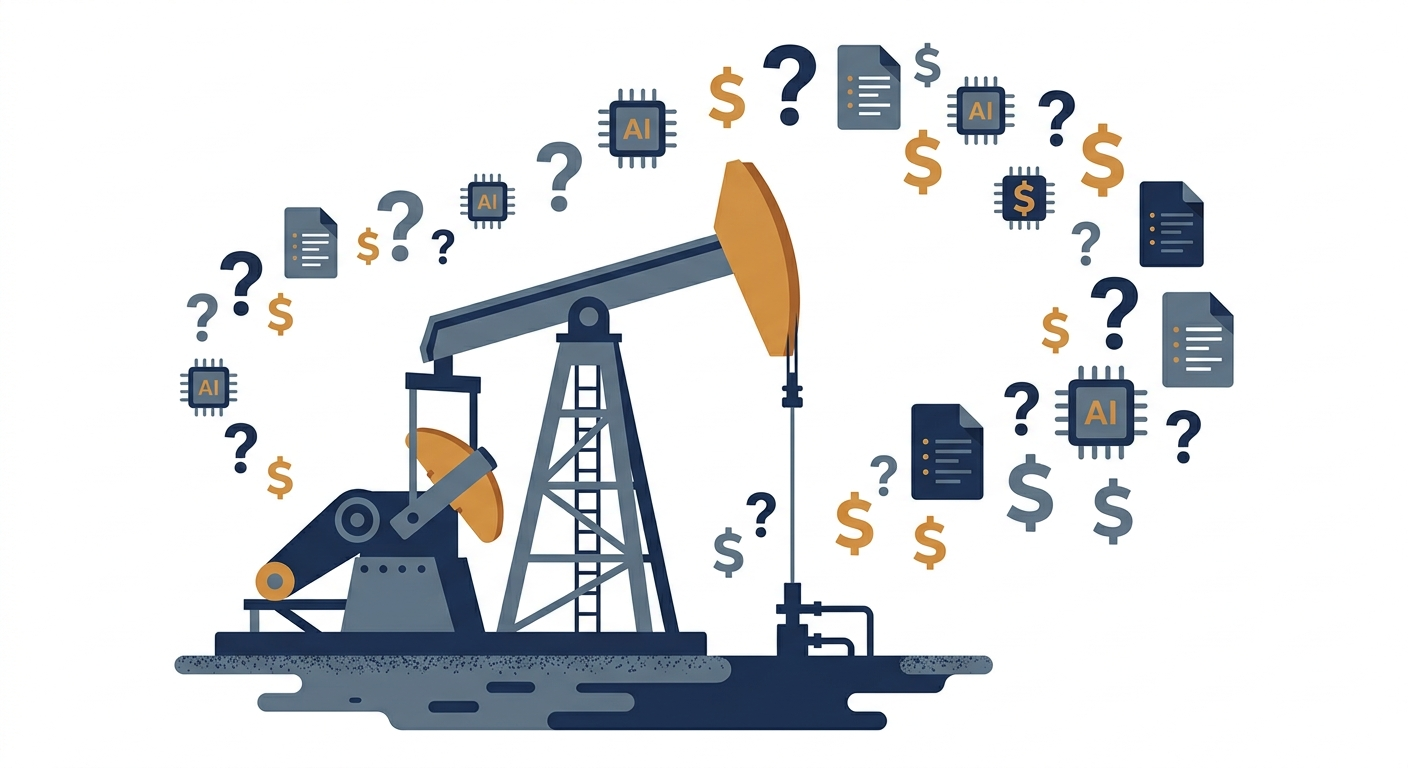
The pitch sounds compelling. One platform. Purpose-built for oil and gas. Speaks your language. Solves everything. But are you sure you know what you are getting?
Why pay for a wrapper between your question and Claude?
Many vertical solutions in this space amount to a curated knowledge base wrapped around the same Claude, ChatGPT, or Copilot you could access directly — with a layer of fees stacked on top for the privilege. The leading models already know what a decline curve is. They understand NRI calculations, JIB statements, completion reports, and wellbore terminology without any specialized training. Before you sign, it's worth asking: do you know what you're actually paying for?
Because here's the deeper problem. The model already knows what a decline curve is. What it doesn't know is why yours doesn't match your lease operating statement. That's not a knowledge problem. That's a connectivity problem. And no vertical fine-tuning solves it.
Here's the question nobody is asking at the signing table: what happens when the market shifts beneath you?
The upstream O&G AI market is moving faster than any vendor roadmap. The tool that leads the pack on capabilities today is a commodity in eighteen months. The platform that feels purpose-built right now was designed around assumptions that may look nothing like where the industry is in two years. AI is not a solved problem — it is an evolving one. And locking your operation into a single vendor's architecture at this moment in the development cycle is a bet that vendor's roadmap will keep pace with a market that has consistently outrun every prediction made about it.
When you go vertical, you don't just buy a product. You buy a dependency.
Vertical AI makes a specific bet.
It bets that the path to value runs through the engineer — through better answers to technical questions, faster access to petroleum knowledge, smarter completions analysis. That's a real problem worth solving. The field has always driven investment in this industry and AI is no different.
But the person running the operation has a different problem entirely. The COO who needs her true lease operating cost across the portfolio — not last month's number, the current one. The CFO modeling cash flow exposure if WTI spikes another ten dollars. The land manager who picked up a new lease last week and needs the production team to know the NRI changed before the economics get run wrong. These aren't field problems. They're business problems. And most of the vertical AI investment in this space isn't pointed at them.
For the independent and mid-size operator, that gap is where the real pain lives.
Operators have already made meaningful investments.
Most upstream firms aren't starting from zero. They have systems of record they've run for years — production software, land systems, accounting platforms, forecasting tools. They have AI tools their engineers are already using. Workflows have been built. There's real utility running inside these organizations right now.
The vertical vendor's implicit message is that most of that needs to go — or at minimum, needs to be subordinated to their stack. You're not just adopting a tool. You're migrating your workflows, your data, and your people into someone else's architecture — at a moment when the architecture of AI itself is still being written.
We think that's the wrong starting point.
Tauris starts from a different assumption.
The systems you run aren't the problem. The fact that they don't talk to each other is the problem. A production engineer runs her decline analysis, flags something, and then wonders why the economics aren't tying to the lease operating statement from the third-party accounting firm. The land team picked up a lease in the unit, so now her NRI changed. These are all separate systems of record that need to talk to one another when something changes. Every handoff is a manual step. Every context switch is a data loss event. And every one of those lost moments is a decision made with incomplete information.
Tauris is the orchestration layer that sits above those systems — connecting what you already run without replacing it. And when a better tool comes along — because one will — you want to be able to swap it in without rebuilding everything around it. Tackle and deploy AI tasks when you need. Fold in what's already working. Keep your options open while the market matures.
That's the bet we're making.
The operator who has already invested, already built workflows, and already has real utility running inside their organization doesn't need a new foundation. They need the layer that makes what they've already built work as one.
Six years ago we made that bet. The last eighteen months of AI development haven't changed it. They've made it more urgent.